Journal
Five Elements for Beginners: A Plain-English Guide to Wood, Fire, Earth, Metal, Water
By Jin Yang · August 17, 2026
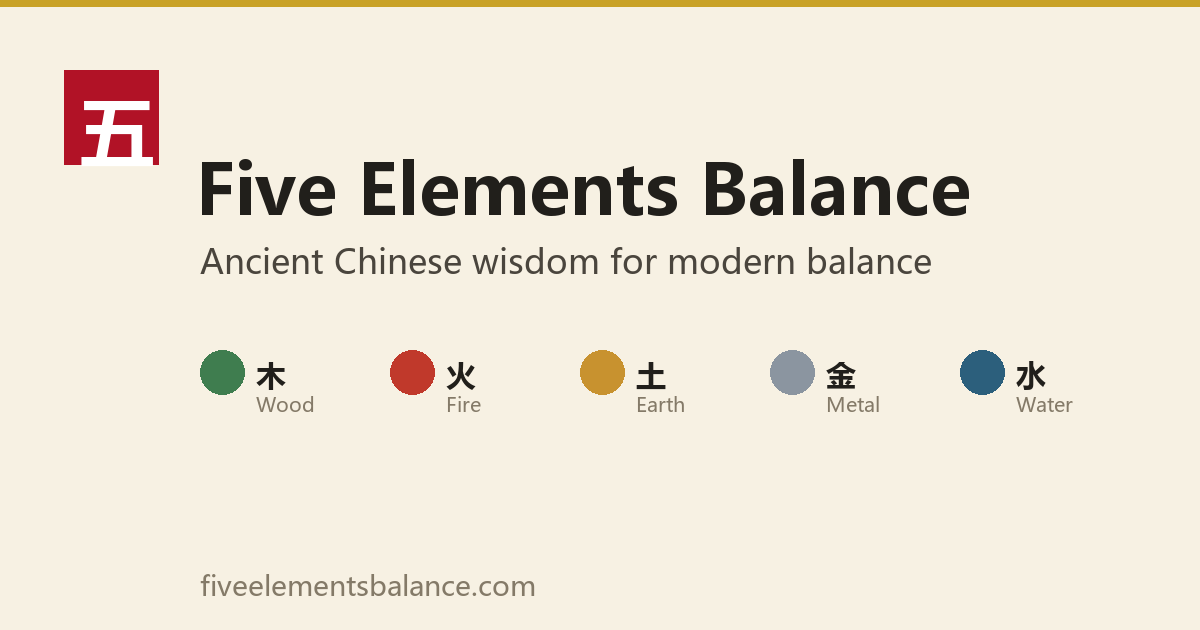
If you’ve landed on a page about “Wood, Fire, Earth, Metal, Water” and felt a step behind, you’re in the right place. This is the beginner’s entry point — no jargon, no diagnosis, just the shape of an idea that’s been organizing Chinese medicine for two thousand years.
The five elements (五行, wǔ xíng — literally “five movements” or “five phases”) are not primitive chemistry. They’re a way of sorting the world into five patterns of energy and behavior. Wood grows, Fire flares, Earth settles, Metal gathers and releases, Water sinks and stores. Once you see the pattern, you start noticing it everywhere: in the seasons, in foods, in your own moods, and in the way your body tilts when it’s stressed.
This is a framework for paying attention and shaping small habits, not a diagnostic system and not medical advice. If you have a health condition, that conversation belongs with your clinician. With that boundary set, here’s the tour.
The five elements at a glance
Each element maps to a season, an organ system, an emotion, a flavor, and a color. The tradition lines them up like this:
- Wood — spring, the liver (肝, gān) and gallbladder, the emotion of anger (怒, nù), the sour (酸, suān) flavor, and the color green.
- Fire — summer, the heart (心, xīn) and small intestine, the emotion of joy (喜, xǐ), the bitter (苦, kǔ) flavor, and the color red.
- Earth — late summer, the spleen (脾, pí) and stomach, the emotion of worry (思, sī), the sweet (甘, gān) flavor, and the color yellow.
- Metal — autumn, the lungs (肺, fèi) and large intestine, the emotion of grief (悲, bēi), the pungent (辛, xīn) flavor, and the color white.
- Water — winter, the kidneys (肾, shèn) and bladder, the emotion of fear (恐, kǒng), the salty (咸, xián) flavor, and the color black.
You don’t need to memorize it. You only need the feel: each element is a kind of weather your body and mind move through.
How the elements move: the generating cycle
The five elements aren’t a list — they’re a circle. The generating cycle (相生, xiāng shēng), sometimes called the “mother-child” cycle, describes how each element feeds the next:
Wood feeds Fire (burning wood makes fire). Fire feeds Earth (ash returns to soil). Earth feeds Metal (ore forms in the earth). Metal feeds Water (the classic image is that metal, when heated, “sweats” condensation). Water feeds Wood (water grows trees).
The practical version: if one element is weak, the tradition often looks to the one before it — “tonify the mother.” A weak Fire might be fed through strong Wood; a weak Metal through strong Earth. It’s a way of thinking in chains rather than parts.
How the elements balance: the controlling cycle
Left to generate forever, the circle would run wild. So the system also includes a controlling cycle (相克, xiāng kè), where each element keeps one in check:
Wood controls Earth (roots hold soil). Earth controls Water (dikes channel flood). Water controls Fire (water puts out fire). Fire controls Metal (fire melts metal). Metal controls Wood (the axe shapes the tree).
Health, in this view, is the generating and controlling cycles in rough balance — enough growth, enough structure, no single element running the show. When one element dominates or collapses, the tradition reads the symptoms as ripples through the chain. Our Five Element Cycle Explained goes deeper on both cycles.
Which element leads in you?
Most people ask this question first, and it’s the right instinct. The tradition treats your dominant element as your “type” — the lens through which you’re most likely to get stuck or shine. A Wood-dominant person tends toward drive and impatience; a Fire person toward warmth and expression; an Earth person toward caretaking and worry; a Metal person toward precision and reserve; a Water person toward reflection and independence.
You’re almost never one pure type. The framework assumes a blend, with a dominant and a secondary — and it assumes the blend shifts a little with the season. The point was never to box you in, but to notice your patterns early enough to tend them.
Where to start if you just want to feel better
You don’t need to master the theory to use it. Three small, traditional moves:
- Eat with the season. Cool, green, sour foods in spring; cooling bitters in summer; warm cooked meals in late summer; moist white foods in autumn; warm dense dark foods in winter. The Five Elements Season Chart lays it out.
- Match the habit to the mood. Tense and stuck? Move like Wood. Wired and overheated? cool like Water. The Five Flavors Balancing guide explains the flavor angle.
- Find your type, then read its page. The Five Element Personality Test gives you a ranking across all five, and What Is My Five Element? walks the logic by hand.
None of this is treatment. It’s attention — the kind that’s easier to keep once you understand why your type needs what it needs.
Quick self-check
| Statement | Feels like me |
|---|---|
| I’m drawn to the idea that my habits follow the seasons | ☐ |
| One element’s description felt more “me” than the others | ☐ |
| I get tense and stuck more than I’d like (sounds like Wood) | ☐ |
| I run hot, wired, or overheated easily (sounds like Fire) | ☐ |
| I worry and hold others together a lot (sounds like Earth) | ☐ |
| I’m reflective, independent, and need quiet to recharge (sounds like Water or Metal) | ☐ |
Four or more checks means the framework is already clicking for you. Whatever you checked, the next step is to find your dominant type and read its page.
Where to go next
- Once you know your ranking, put it to work: A Five Element Self-Care Routine turns each element into a week of care.
- Take the Five Elements Personality Test to see your ranking across all five.
- Read What Is My Five Element? for the hand-walk through the logic.
- See all five types mapped in Five Element Personality Types.
- Get the full correspondence table in The Five Elements Chart.
- Learn how the elements move in The Five Element Cycle Explained.
- Want the same idea in even fewer words? Five Elements Explained Simply.
Shop the pantry
As an Amazon Associate, Five Elements Balance earns from qualifying purchases.