Wood Element
Wood Element Meaning in Chinese Medicine: Spring, Liver, and the Urge to Grow
By Jin Yang · August 3, 2026
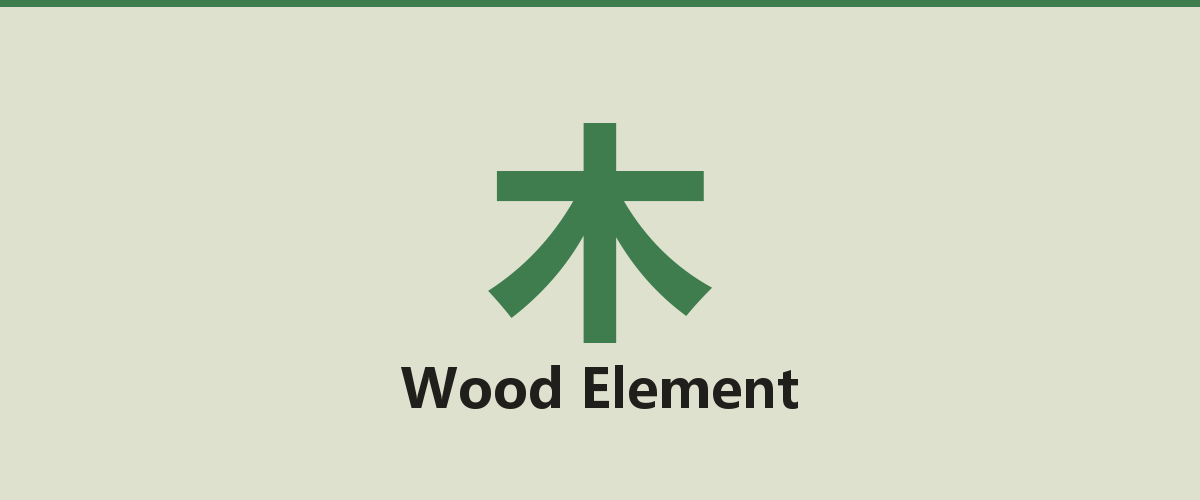
Ask ten people what the Wood element means and you’ll get ten answers, most of them vague. “Growth.” “Green.” “Trees, I guess.” That’s not wrong, but it’s like describing jazz as “music with horns” — technically accurate, entirely unhelpful.
In Chinese medicine, Wood (木, mù) is one of the five phases that organize how the tradition sees the natural world and the human body inside it. It isn’t a substance. It’s a movement — specifically, the movement of energy pushing outward and upward after a period of stillness. Spring is Wood. A seed cracking its shell is Wood. The moment you decide to finally start the thing is Wood.
The Yellow Emperor’s Inner Canon (《黄帝内经》), the foundational text compiled more than two thousand years ago, pairs each phase with a season, a pair of organ systems, an emotion, a flavor and a color. For Wood the set is spring, the liver (肝, gān) and gallbladder (胆, dǎn), the emotion of anger (怒, nù), the flavor Sour (酸), and the color green.
One clarification before we go further: this is a traditional framework for understanding patterns and making lifestyle choices. It’s a lens, not a diagnosis, and nothing here is medical advice. If something in your body concerns you, that’s a conversation for a clinician.
What Wood actually describes
The clearest way to understand Wood is to watch what it does rather than what it is.
Wood is the phase of initiation and direction. In the classical scheme, energy in winter sinks and stores (that’s Water). In spring it turns and rises. Wood is that turn — the change from potential into motion. Everything the tradition associates with Wood follows from that one idea:
- Growth with a direction. Not sprawl. A tree grows toward light. Wood energy is purposeful, not random.
- Flexibility under pressure. A branch bends in wind and springs back. Rigidity is a sign that Wood has lost its quality, not gained it.
- Breaking through obstruction. Roots split rock. Wood is the phase that handles resistance.
That’s why the liver, in the traditional reading, is described as governing the “free and easy flow” of qi (气) throughout the body. The liver in Chinese medicine is not the same object as the liver in your anatomy textbook. It’s a functional system — a description of how smoothly energy, emotion and blood move — that happens to share a name with the organ.
Wood’s season, organs, and body signs
Season: spring. The classics advise waking earlier in spring, loosening your clothing and your hair, and walking outdoors — literally letting the body’s upward push have somewhere to go. Compressing spring, in the traditional view, sets up problems for the summer that follows.
Organs: liver and gallbladder. The liver is said to store blood and regulate flow; the gallbladder governs decisiveness and courage. The classical phrase for someone who hesitates endlessly implicates the gallbladder, not a lack of information.
Body regions. Wood claims the tendons and sinews, the eyes, and the nails. Traditional practitioners reading a Wood pattern will look at flexibility, eye clarity and nail texture — not because those are magic, but because in this system they all sit downstream of the same organ network.
Hours: 1 to 3 a.m. is the liver’s window on the traditional body clock. Reliably waking in that stretch is a classic Wood tell, which is why so many people who describe themselves as “wired and frustrated” also describe 2 a.m. ceiling-staring.
Balanced Wood versus stuck Wood
Here’s where the framework earns its keep — it describes two very recognizable states.
When Wood flows well, you’re decisive without being reckless. You make plans and adjust them without drama. Frustration comes and goes rather than settling. Your body feels loose, your vision is clear, and pressure motivates you instead of stiffening you.
When Wood gets stuck — the pattern traditionally called liver qi stagnation (肝气郁结, gān qì yù jié) — the same energy turns inward and grinds:
- Tight shoulders, jaw and neck; a band of pressure under the ribs
- Frequent sighing, which the tradition reads as the body’s own release valve
- A shorter fuse than usual, often followed by guilt about the shorter fuse
- Tension headaches, especially at the temples
- Feeling simultaneously restless and unable to start anything
Notice what these have in common: they’re all movement that has nowhere to go. That’s the entire Wood diagnosis in one sentence, and it’s also the key to working with it.
How the tradition works with Wood
The classical advice for Wood is almost never “calm down.” It’s “give it a channel.”
Move first, think second. For a Wood-heavy system, a brisk twenty-minute walk does more for a stalled mood than an hour of trying to reason with it. The tradition’s spring guidance — walk outdoors, stretch, unbind — is essentially a prescription for physical outflow.
Add a little sour. Sour (酸) is Wood’s flavor, and the classics say it gathers and consolidates. In practice: lemon in warm water, a vinegar-dressed salad, pickled vegetables alongside a heavy meal. A little is supportive; a lot, according to the same texts, over-tightens.
Eat green, and eat it fresh. Leafy greens, sprouts, young herbs — spring foods for a spring phase. Modern nutrition happens to agree that dark leafy greens are among the most nutrient-dense foods available, which is a pleasant convergence rather than a proof.
Something floral in the evening. Rose buds (玫瑰花, méi guī huā) are the traditional pick for gently moving stuck liver qi, and a warm cup at the end of the day is a fine ritual regardless of what you believe about the mechanism. Our Rose & Citrus Tea for Wood is built on that idea — a ritual, not a treatment.
Stretch the sides of your body. The liver channel runs up the flanks. Side bends and twists are the traditional release for Wood tension, and they feel exactly as good as that suggests.
Wood’s relationships with the other elements
Wood doesn’t exist alone. In the generating cycle, Water nourishes Wood (rest and reserves feed drive) and Wood generates Fire (drive feeds enthusiasm and warmth). In the controlling cycle, Metal cuts Wood (structure and boundaries keep growth in check) and Wood controls Earth (drive keeps the digestive center from getting sluggish and stuck).
This matters practically. If your Wood runs hot and irritable, the tradition doesn’t only look at Wood — it asks whether Water underneath is depleted. A person running on four hours of sleep will look exactly like a Wood excess, and no amount of sour flavor fixes a sleep debt.
Quick self-check
| Statement | Feels like me |
|---|---|
| I feel physically tense when plans stall or change | ☐ |
| I sigh a lot without noticing I’m doing it | ☐ |
| Stress makes me irritable before it makes me tired | ☐ |
| I wake between 1 and 3 a.m. more often than I’d like | ☐ |
| Movement resets my mood faster than rest or talking does | ☐ |
| I carry tension in my shoulders, jaw, or along my ribs | ☐ |
Four or more checks suggests Wood is a loud voice in your system — worth reading the deeper guides below. One or two is normal; almost everyone borrows a little Wood.
Where to go next
- Read the full Wood element overview for the organs, foods and seasonal rhythm in one place.
- If the traits sound like you, go deeper in The Wood Element Personality or check the signs in Am I a Wood Element?.
- Working with spring specifically? Spring Liver Care covers the seasonal practices.
- For the organ deep-dive, read Wood Element & the Liver.
- Picking a daily tonic for the liver? See Best Tea for Liver Detox for what a real formula looks like.
Shop the pantry
As an Amazon Associate, Five Elements Balance earns from qualifying purchases.